


If you work across both D365 Customer Engagement (Sales, Customer Service, Field Service, Customer Insights) and D365 Finance & Operations (D365 FSCM), you’ve probably noticed something:
The experiences are not identical.
Sometimes a Sales or Customer Service user demonstrates a feature and someone from the FO side asks:
“Wait… why don’t we have that?”
It’s a fair question.
And the answer is architecture, specifically, current architecture.
It Starts with How the Products Are Built (Today)
D365 Customer Engagement applications are built on Microsoft Dataverse.
Dataverse is a modern, cloud-native platform designed for flexibility, extensibility, and rapid enhancement. Because CE applications share this foundation, Microsoft can more easily introduce AI-driven capabilities like contextual Copilot experiences, Smart Paste, and intelligent form suggestions directly into the user interface.
D365 FSCM, by contrast, still operates on a more traditional ERP architecture. It is engineered for financial control, operational precision, compliance, and high-volume transactional processing. Its structure supports complex accounting frameworks, inventory valuation models, costing logic, regulatory requirements, and strict audit trails.
That structure brings strength, but also constraints.
FSCM environments typically serve a wide range of users with highly granular security roles: finance managers, AP clerks, controllers, warehouse workers, procurement teams, production planners, and more. Introducing assistive AI features into that ecosystem requires careful evaluation of data access, security boundaries, financial impact, and audit implications.
So, when you see differences in user experience, you are seeing architectural maturity at different stages. And more importantly, this is about where the platforms are today.
Microsoft’s long-term direction clearly signals continued modernization. FSCM is evolving, and over time, its architecture will continue moving toward greater cloud-native alignment and deeper AI integration.
Let’s go through few of these functions that are currently available in CE applications that are not yet available in D365 FSCM:
Copilot Sidecar: Conversational Data Awareness
In both Customer Engagement apps and FSCM, Copilot sidecar can act as a contextual assistant.
In CE applications specifically you can ask Copilot sidecar to:
- Summarize an opportunity
- Explain recent activity on an account
- Identify open cases
- Highlight pipeline risks
Because CE apps run on Dataverse and optimized for interaction based workflows, Copilot can access related records and generate real-time summaries of the application data in natural language.
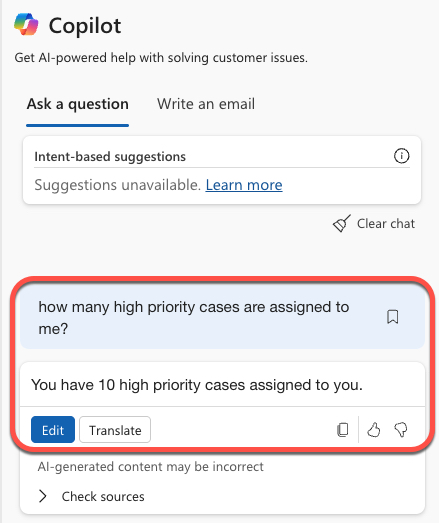
In FSCM, Copilot capabilities exist, particularly around financial insights, invoice matching, and process guidance, but the conversational, record-level “ask about this data” sidecar experience is not yet embedded into transactional forms. Today, the sidecar experience in FSCM is more focused on product guidance and Microsoft Learn-based assistance rather than live transactional data summarization.
The reason is architectural.
ERP transactions affect ledgers, subledgers, inventory cost layers, tax calculations, and compliance reporting. The downstream impact of a misinterpreted transaction is significantly greater.
When financial integrity is involved, guardrails matter.
Smart Paste: From Unstructured to Structured
Customer Engagement applications recognize something very practical:
Customer-facing work often begins in unstructured formats;
Emails.
Meeting notes.
Copied signatures.
Customer inquiries.

Smart Paste allows users to copy messy text into a form and receive intelligent suggestions for structured fields, name, company, subject, phone number, description, and more.
That functionality is well-suited to CE applications because Dataverse is optimized for flexible data handling and user interaction.
In FSCM, there are several places this functionality would be helpful like when creating a vendor or a contact, but as of now, this is not yet available.
Drag-and-Drop Intelligence and AI Suggestions
In CE applications, users can drag files into records and leverage AI to summarize content or suggest next steps. The system assists in interpreting uploaded documents and connecting them to structured data.

This aligns with how Sales and Service users operate, in conversations, proposals, communications, and evolving customer interactions.
FSCM supports document attachments and SharePoint integration, but it does not typically analyze uploaded content and suggest transactional updates during master data creation currently.
Where This Is Headed
It’s important to emphasize:
These differences reflect the system’s current anatomy, not a permanent diagnosis.
Microsoft’s roadmap is clearly centered on deeper AI integration across the entire D365 ecosystem. Customer Engagement may be further along in certain Copilot experiences today, but FSCM is evolving. As its architecture modernizes, we can expect more embedded intelligence within ERP workflows.